
Shep and the Montana School for the Deaf and Blind history
 For Shep’s 80th anniversary in 2022, members of the Historical Society held a commemorative event with key members of Shep’s story. Dressed in character, they told the story and BNSF presented a check to MSDB for the Shep Fund. We hope this is not the last time this story of loyalty is told publicly because Shep’s impact has been steadfast for students on campus. Over the past 82 years, we have shared it at Christmastime with thousands of Boomers, Gen X, Millennials, Gen Z, and now Gen Alpha. It is our hope that this award will inspire others to retell this story to more of Montana’s children.
Shep’s story takes place in the town of Fort Benton, Montana. In 1936 a sheepherder became ill and was brought to the St. Clare Hospital in Fort Benton, he was accompanied by an old sheepdog. The dog followed the herder into town and watched him taken into the building. Although he was not allowed inside, Shep kept a constant vigil outside the hospital. A kind nun, who ran the hospital’s kitchen, took pity on the loyal dog and kept him fed. A few days later, the man died.
After the sheepherder’s death, a family member back East requested that the body be brought back home for burial. The sheep dog watched as his master’s body was loaded by the undertaker onto the train. It’s said that people who were present later recalled the dog whining as the train door was shut, and they remembered him pawing at it. As the engine slowly pulled away from the station, the dog tried to pursue, but couldn’t keep up and abandoned the chase. He returned to the station in defeat.
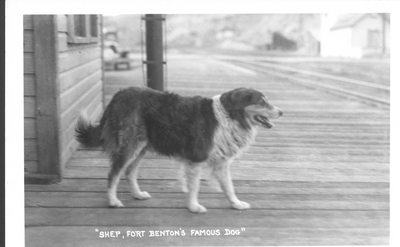
Shep, courtesy of the Montana State University Library.
So began a five-and-a-half year vigil. No one remembers the name of the man, but the railroad workers began to call the dog Old Shep. Every day following the disappearance of his master, Shep met each of the scheduled trains that arrived at the station. He became a regular feature there, standing on the platform watching each passenger in the hopes that one would be his long lost master.
Tony Schanche, the station agent admired the dog’s devotion and loyalty so he allowed Shep to live under the station platform. He and other railroad workers kept Shep fed. Many folks tried to befriend him, but he was clearly not interested as he was just patiently waiting for the return of his master. Around two and a half years into his long watch, Shep was featured in the newspaper column Ripley’s Believe It or Not. Shep became a Depression-era sensation. Fan mail poured in and school children sent Christmas gifts. Rail travelers took out of the way detours just to stop in Fort Benton to get a glimpse at this devoted dog meet their train at the station. Money was occasionally being sent with specific requests that it be used to help take care of the dog.
In January 1942, Shep was standing with his front paws on one of the rails waiting, as usual, for the next train to come in. Probably because of his age, he simply did not hear the train until it was too late. He slipped on the rail and was hit despite the engineer’s attempt to stop.
Because of his fame, Shep’s obituary was carried over the wire services. His funeral was held two days later and was attended by hundreds of people. Shep even had an honor guard and pall bearers. The funeral ended with a Boy Scout sounding taps on the bugle. Shep was buried on a bluff overlooking the train depot. Workers from the Great Northern Railroad put up a simple obelisk, with a painted wooden cutout of Shep next to it. Just beneath it, some white stones spelled out SHEP. They put up lights to illuminate the burial site at night, and conductors would often point it out to their passengers. Eventually, though, the passenger line stopped coming through Fort Benton, the lights went out, and the grave fell into disrepair.
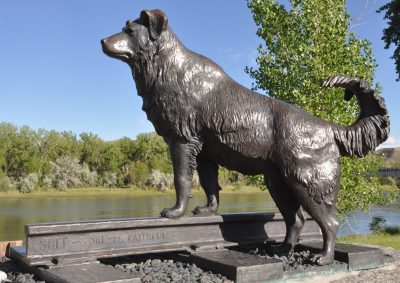
In 1988 radio broadcaster Paul Harvey, gave a retelling of Shep’s story. In response to that broadcast, the monument was repaired and refurbished. The Shep cutout is now made of steel, and lights are back up. In 1994, the town unveiled a larger than life statue of Shep cast in bronze with both front feet on a train rail. The money for the statue was raised by donations, the selling of miniatures of the statue as well as memorial bricks which were placed in a thirty-foot octagon beneath it.
Shep’s statue is not the final legacy of his faithfulness. The money that had been sent in by caring people to support the dog’s vigil eventually grew to such an amount that after his death the funds were used as an endowment to the Montana School for the Deaf and Blind. Even today, the “Shep Fund” is still providing children with hearing aids, guide dogs, and educational tuition assistance.
Dogs are truly amazing and this story highlights the fact that dogs possess the greatest loyalty and love that can transcend the life of any individual.
Information courtesy of Ken Robison and the Overholser Historical Research Center
Contact Us
Montana School for the Deaf & Blind Foundation
P. O. Box 6576
Great Falls, MT 59406
406-771-6040
foundation@msdb.k12.mt.us